








Roblox: Timebomb Duels
All trademarks belong to their respective owners.
Popular Reviews







Three seconds is how long I had the bomb.
Player4 had just tossed it to me across the arena. I could see the timer flashing red on the model attached to my character, ticking down: 3.9, 3.8, 3.7. I panicked, whipped around, tried to lock onto the nearest opponent — a low-level named player with a beginner cosmetic outfit standing near the platform edge. I swung the pass just as they moved. The bomb sailed past them and into open air, where the physics carried it two more meters before the timer hit zero.
The explosion took me out. Not the low-level player. Not Player4 who'd thrown it to me. Me. Because in Timebomb Duels, when the bomb explodes and you're the one holding it — or the one closest to it when it detonates in mid-air — you're the one who dies.
The whole round lasted forty-seven seconds. I was one of the first eliminated. I hit "play again" immediately.
That is Timebomb Duels. That's the whole pitch. Explosive rounds under a minute. Chaos physics. Immediate re-queue. The hot potato game reduced to its purest, most stressful form.
What This Game Actually Is
Timebomb Duels is a fast-paced multiplayer Roblox experience where six to sixteen players spawn on a floating arena, one player begins holding a ticking bomb, and players attempt to pass the bomb to each other before it explodes. The player holding when the bomb detonates is eliminated. Rounds continue with a new bomb until only one player remains, who wins.
The core mechanic is deceptively simple. You can:
- Move around the arena using standard Roblox controls
- Throw the bomb at any player you can see (mouse-aimed on PC, tap-target on mobile)
- Dodge incoming bomb throws by moving out of the trajectory
- Interact with map elements — platforms that shift, hazards that clear, power-ups that appear
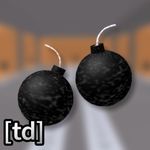
The bomb has a visible timer that starts at approximately five seconds and counts down. When someone catches or is hit by a thrown bomb, they inherit the current timer — no reset. This means the closer to zero the timer gets, the more desperate the pass-passing becomes, until eventually someone can't unload it fast enough and gets caught in the explosion.
That's it. That's the entire game. And that simplicity is why it works.
Why Fifty-Second Rounds Are the Ideal Format for This
I want to spend real time on the round pacing because it's the design decision that determines everything else.
Timebomb Duels rounds typically last thirty seconds to two minutes. The average is somewhere around forty-five seconds. Individual eliminations happen constantly — someone gets caught, they respawn spectating, they wait a few more seconds until the last player is eliminated, then the next round starts. From starting a match to being back in a fresh round after elimination: usually under two minutes total.
This is ideal pacing for a stress-relief casual game.
Compare it to games with longer round structures. A five-minute battle royale round means when you get eliminated in the first minute, you have four minutes of dead time before the next round starts. A ten-minute MOBA match locks you in for the full duration once you commit. These games can be enormously rewarding but require sustained attention.
Timebomb Duels never demands more than a minute of engagement at a time. You can play it while doing something else. You can play it in five-minute breaks. You can play it in longer stretches for an evening of pure stress-based entertainment. The pacing accommodates every play window.
The Skill Layers, Because There Are More Than You'd Think
At first glance, Timebomb Duels looks like pure chaos. You catch a bomb, you throw it at someone, you either hit or miss, you win or die. Not much skill involved.
Play twenty rounds and you start noticing the skill layers.
Awareness is the first. Where are you positioned relative to the bomb-holder? Who has thrown the bomb at whom recently? Who is likely to target you next? Better players are constantly tracking the arena state and pre-positioning to be either safe from incoming throws or ready to receive and quickly re-pass.
Movement is the second. The arena has geometry — platforms, obstacles, safe zones. Skilled players use movement to make themselves harder targets. Predictable straight-line running is easy to hit. Zig-zag movement with occasional jumps is much harder to target. The best players almost never stop moving.
Throw timing is the third. When you receive the bomb, you have to make an immediate decision: throw immediately to unload the timer, or hold briefly to line up a better target? Panic throwers unload immediately at whoever is closest, often missing. Skilled players briefly hold, aim carefully, and land throws consistently even with two seconds on the timer.
Target selection is the fourth and most sophisticated skill. You could throw at the low-level player who's clearly new. You could throw at the veteran player who's a threat if they survive to endgame. You could throw at the player who just threw at you (revenge play). You could throw at whoever is currently closest to a hazard, hoping they can't unload before dying to environmental damage. Different situations reward different target choices, and mastering this is what separates casual players from serious ones.
The Maps: More Than You'd Expect
Timebomb Duels has multiple maps that rotate through matches. Each map has different geometry and hazards that change how the game plays.
The basic arena is a flat platform with minimal geometry. This is the "pure" version of the game — pure skill, pure movement, no environmental factors. It's where new players learn.
The shifting platform map has floating platforms that periodically move. Standing still is dangerous because platforms can drop out from under you. This map rewards active movement and constant re-positioning.
The lava pit map surrounds the play area with instant-death environmental hazards. Getting knocked off, dropped through, or forced into the lava is an alternative death condition. Skilled players use throws to knock less-skilled opponents into hazards.
The maze arena is a more complex geometry map with blind corners and hiding spots. Line-of-sight matters here in ways it doesn't on open maps. You can genuinely hide from a bomb-holder for a few seconds if you play it right.
The map variety keeps the game from wearing thin. What would be repetitive on a single arena stays fresh across the rotation.
The Cosmetic Loop
Because this is a Roblox game, there's a cosmetic progression layer beneath the round-to-round gameplay.
You earn currency by playing rounds. Winning rounds earns more currency than losing rounds. The currency is spent on cosmetic bombs (visual variants of the ticking bomb model), character skins, victory animations, and other pure-cosmetic items.
None of the cosmetics affect gameplay. There is no gear system. There is no progression that gives you mechanical advantages. This is important — Timebomb Duels avoids the pay-to-win trap that many Roblox competitive games fall into.
There are Robux gamepasses that grant exclusive cosmetic items. These are meaningful only for players who want to visually differentiate themselves. Skilled free players regularly beat premium cosmetic buyers because skill, not cosmetics, determines outcomes.
For a Roblox competitive game, this monetization approach is refreshing. It's not the norm.
Where This Game Falls Short
Being honest about the weaknesses:
Session length ceiling. Timebomb Duels is a snack game. It's excellent for fifteen-to-forty-minute play sessions and unsuitable for multi-hour play. Round variety runs out after a while, and the specific pleasure of the game is best experienced in shorter chunks.
Matchmaking is basic. There's no serious ranked ladder. Players of all skill levels mix in the same lobbies, which means new players can face veterans in their first match. The developer has been iterating on this but skill-based matchmaking remains basic.
Server hiccups happen. Roblox's shared infrastructure occasionally hitches, which in a time-sensitive game like this can produce feel-bad moments (a throw registers late, you inherit a bomb you visually caught after the timer expired). Most sessions are fine but hiccups happen.
Not for players who dislike chaos. If you specifically want tactical, deliberate multiplayer experiences, this is the wrong game. Timebomb Duels is loud, fast, and chaotic. That's the appeal, but it's also the reason some players bounce off immediately.
Communication is minimal. No voice chat integration for tactical coordination, though the fast pace of the game makes coordination mostly unnecessary. But if you're looking for team-based cooperative play, this isn't it — this is a free-for-all elimination game.
Who Should Play This
Play Timebomb Duels if: you want stress-relief casual multiplayer that respects your time. Play it if: you like chaotic party games with immediate rounds. Play it if: you have friends who play Roblox and want a quick shared game. Play it if: you specifically enjoy hot-potato mechanics or elimination-format play.
Skip it if: you want tactical strategic multiplayer experiences. Skip it if: you play primarily solo (this only makes sense in populated lobbies). Skip it if: you dislike Roblox as a platform. Skip it if: you need progression and mechanical advancement to stay engaged.
This is not a deep game. It's not trying to be. What it delivers is one specific pleasure — the frantic minute-by-minute chaos of the hot potato format, rendered with just enough polish and enough map variety to sustain long-term casual play — at zero cost with immediate availability on any device that runs Roblox.
Three seconds. Two seconds. One second. You're not going to make the throw in time. You look for the nearest opponent, you swing, the timer hits zero, and everyone in the arena either laughs or screams. That's Timebomb Duels, distilled. It's simple, and it works.
Load the game. Join a lobby. See how long you can hold a bomb before you can't hold it anymore.